ARTICLE 67

by
Stephen M. Phillips
Flat 4,
Oakwood House, 117-119 West Hill Road. Bournemouth. Dorset BH2 5PH.
England.
Website: http://smphillips.mysite.com
Abstract
|
The numbers 168, 336,
672, 840 & 1680 are structural parameters of the UPA, which the
Theosophists Annie Besant and C.W. Leadbeater claimed in 1895 are the
basic constituent of atoms that they remote-viewed with the aid of a
yogic siddhi. These numbers can be represented by concentric, square
arrays of 13, 29 & 41 dots, each dot denoting the number 1.
Construction of the first four Platonic solids from triangles generates
these numbers as the numbers of geometrical elements that surround their
axes. That this cannot, plausibly, be due to chance is supported by the
fact that, when regarded as Type A polygons, the faces of the first four
Platonic solids are composed of 248 points & lines, where 248 is the
dimension of E8, the rank-8, exceptional Lie group present in
E8×E8′ heterotic superstring theory. Furthermore,
for all five Platonic solids, 496 geometrical elements other than
vertices on average surround an axis, where 496 is the dimension of
E8×E8'. This is a geometrical connection provided
by the Platonic solids between two group-theoretical parameters
intrinsic to E8×E8′ heterotic superstring theory and
paranormally-derived, structural parameters of the UPA. It is evidence
for the latter being a state of the
E8×E8′
heterotic superstring (according to the author’s previous researches,
the UPA is the basic constituent of up and down quarks). The Tetrad
expresses these parameters arithmetically, whilst the square (symbol of
the Tetrad) represents them geometrically. These parameters illustrate
par excellence the Tetrad Principle that has been proposed by the
author.
|
1
Figure A
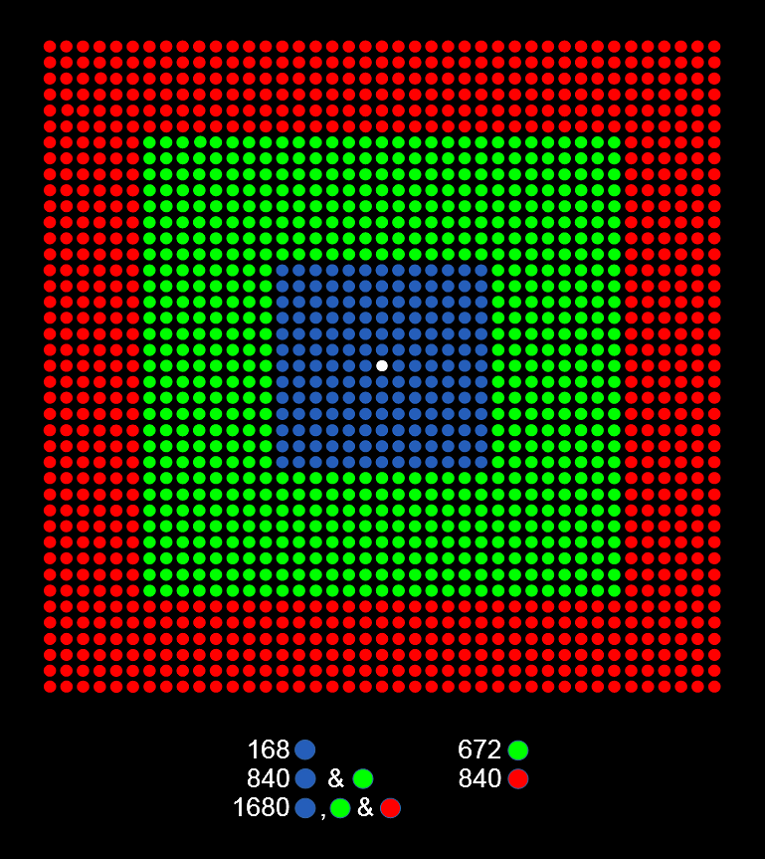
Square representation of structural parameters of the
UPA/subquark state of the E8×E8′ heterotic superstring.
|
Figure C
|
Figure D
|
|
|
3
5
7
9
25
11
23
13
21 19
17
15
|
|
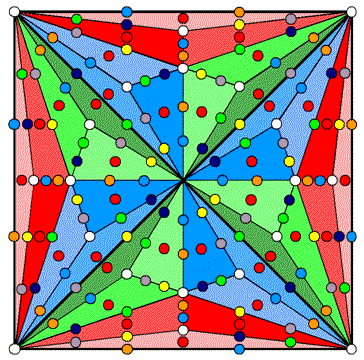
168 yods surround the
centre
of the Type C square.
|
The sum of the 12 odd
integers after 1
that line the sides of a square is
168. |
2
The n×n square array of n2
yods has (n2−1) yods surrounding its central yod when n is an odd
integer (when n is even, no yod is at the centre of the array, so discussion will
focus on odd values of n), for which there is such a yod. For n = 13,
(132−1=168) yods (coloured
blue
|
|
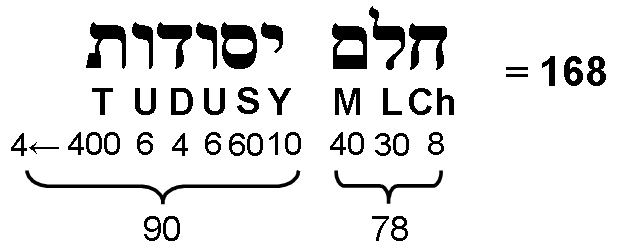
in Fig. A) surround the centre. This is the gematria number
value of Cholem Yesodoth, the Mundane Chakra of
Malkuth, which is the last of the 10 Sephiroth of the Tree of Life
(see
here). The UPA (“Ultimate Physical Atom”) is the basic unit of
atomic matter described by Annie Besant & C.W. Leadbeater with
anima, one of the siddhis, or paranormal powers, gained
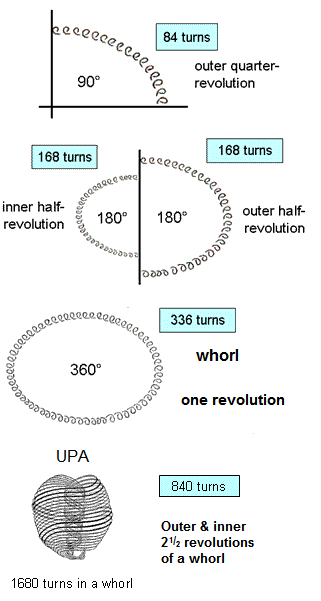
through Indian yoga. It comprises 10 helical whorls (Fig. B).
Each whorl has 1680 circular turns and winds five times around the
axis of spin of the UPA. Its outer coil with 840 turns spirals
2½ times around this axis and
returns to its starting point via a narrower spiral with 840 turns,
winding another 2½ times
through the core of the UPA. Each revolution comprises 336 turns and
each half-revolution consists of 168 turns. Each blue yod denotes one
turn as a circularly polarized oscillation created by the
superposition of two orthogonal plane waves that oscillate
90° out of
phase.
For n = 29, the central yod of the 2929 square array of yods
in Fig. A is surrounded by (292−1=840) yods. Outside the array of 168
blue yods are (840−168=672)
green yods surrounding its centre. The 840 green & blue yods
denote either an inner or an outer half of a helical whorl, each with
840 turns.
For n = 41, (412−1=1680) yods surround the
central yod in
the 41×41 square array. The 840 red
yods outside the 29×29 array denote the 840 turns making up either an
outer or an inner half of a whorl. The
two sets of 840 yods denote the two
halves of each whorl of the UPA. It is not necessary here to choose
which set corresponds to which half, although it seems natural to
remain consistent with the analogy by regarding the two inner squares
with 840 green and blue yods as symbolising the inner half of the
UPA.
|
|
Figure B
|
The number 29 is the 10th prime number and the 15th odd integer, where 15 is
the number value of YAH (יה), the Godname assigned to Chokmah, which is
the second member of the Supernal Triad of the Tree of Life. The number 41 is the
21st odd integer, where 21 is the number of EHYEH (אהיה), the Godname that is assigned to Kether, the first member of the Supernal
Triad. This is the arithmetic way in which EHYEH prescribes each whorl of the UPA as
the microphysical manifestation of the Tree of Life blueprint, its 10 whorls
corresponding to the 10 Sephiroth of the latter
The Type A n-gon (see also here) has n sectors that
are tetractyses; it has (6n+1) yods. The Type B n-gon has sectors made up of three
tetractyses, i.e., they are Type A triangles; it has (15n+1) yods. The Type C n-gon has
Type B triangles as its sectors; it has (42n+1) yods. For the square (n=4), 168 yods
surround its centre (Fig. C).
As
n2 − 1 = 3 + 5 + 7 + …
(2n−1),
132 − 1 = 3 + 5 + 7 + 9
+ 11 + 13 + 15 + 17 + 19 + 21 + 23 + 25 = 168.
The number 168 is the sum of the first 12 odd
integers after 1. When the square is constructed from tetractyses, Type A triangles,
Type B triangles, etc., there are always four yods spaced evenly along each of its
four sides (this is true, of course, for any polygon). This
means that 12 yods line its sides, creating its shape. The square is an ancient
symbol of the four Elements Fire, Air, Water & Earth that the ancient Greeks
believed were the ingredients of matter. They are associated with Malkuth, the
Sephirah that denotes the material form of anything designed according to this
blueprint. It is therefore appropriate that the gematria number value of this
Sephirah is the sum of the first 12 odd integers that can form the boundary of the
geometric symbol of the four Elements. The sum
of the first six odd integers (coloured blue in Fig. D) that are four units
apart is 78, the sum of the remaining six red integers being 90. These numbers are
the number values of the Hebrew words Cholem and
Yesodoth making up the Kabbalistic name of the Mundane Chakra of
Malkuth:
As
84 = 41 +
42 + 43
and
The tenth letter of the
Hebrew alphabet is yod (י). Shaped somewhat like a dot, this word is used by the author to
denote each point or dot in the Pythagorean tetractys symbolising the number 10, as
well as in any other array of points, such as those discussed in this
article.
3
336 = 4×84 = 42 +
43 + 44,
the Tetrad (4)
expresses the number of turns in each revolution of every
helical whorl of the UPA (see Fig. B).
Alternatively, as
84 = 12 +
32 + 52
+ 72,
336 is the sum of the squares of the
first four even integers that are spaced four units
apart:
336 = 4×84 = 22×(12+32+52+72) =
22 + 62
+ 102 +
142.
This illustrates the author’s Tetrad Principle, discussed in
his Article1.
Analogy with the first four Platonic solids
The ancient Greeks thought that the particles of the four physical Elements
have the shapes of the first four Platonic solids: the tetrahedron, octahedron, cube
& icosahedron. The tetrahedron with four vertices and six faces was the shape of the particles of Fire, the
octahedron
|
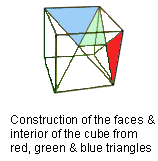
Figure E
|
with six vertices and eight faces was the shape of the
particles of Air, the cube with eight vertices and six faces was the
shape of particles of Earth and the icosahedron with twelve vertices
and twenty faces was the shape of particles of Water. The
dodecahedron, the fifth and last Platonic solid with twenty vertices
and twelve faces, came to be associated with Aether, the fifth
Element. When the centre of a Platonic sold is joined by straight
lines to its vertices and to the centres of its faces, this creates
internal triangles having as one side either an edge or a side of a
sector of its faces. The cube shown in Fig. E is an example of this
construction. There are three types of triangles, the red and blue
ones having one side that is an edge of the cube and the green triangles having
one side that is the side of a sector of a face. The table shown
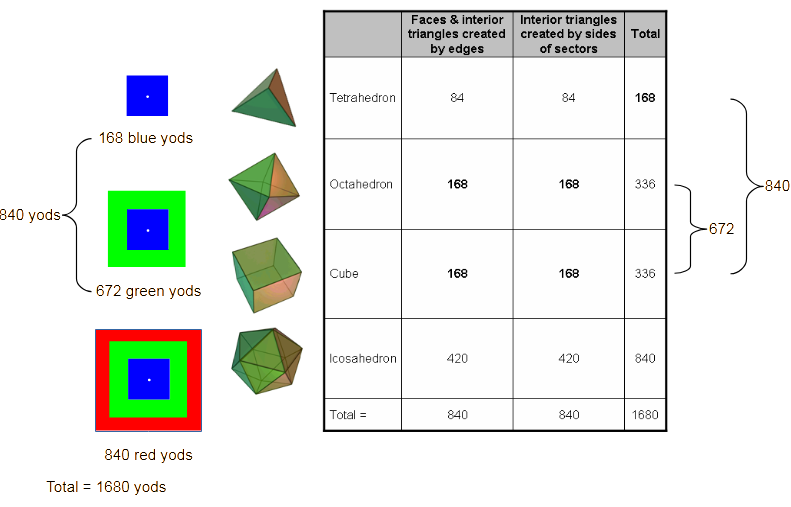
below in Figure F lists the number of points, lines & triangles
that surround the axes of the first four Platonic solids when their faces are Type A polygons and all internal
triangles formed by joining their centres to their vertices and
centres of faces are Type
A
|
|
|
|
Figure F. Analogy between
the three squares and the first four Platonic solids.
|
Surrounding its axis:
-
the tetrahedron has 168 geometrical elements (84 in faces & interior triangles generated by edges and 84 in interior triangles generated by sides of sectors of faces);
-
the octahedron has 336 geometrical elements
(168
in faces & interior triangles generated by edges and 168
in interior triangles generated by sides of sectors of faces);
-
the cube has 336 geometrical elements
(168
in faces & interior triangles generated by edges and 168
in interior triangles generated by sides of sectors of faces);
-
the icosahedron has 840 geometrical elements (420 in faces &
interior triangles generated by edges and 420 in interior triangles generated by sides of sectors of
faces);
4
A sceptic towards the paranormal may argue that it could be just coincidence that three numbers (168, 840 & 1680)pertaining to alleged remote-viewing of subatomic
particles are all of the form n2 − 1, where n is an odd integer integer, in which case their representation by square arrays of dots
lacks significance. This point of view is rendered implausible by the appearance of the very same set of numbers in the geometrical composition of the four Platonic solids
that the ancient Greeks believed were the shapes of the particles of the four physical Elements. The sceptic cannot, reasonably, contend that miraculous chance can also account for
how exactly the same sequence of numbers is displayed by the geometrical composition of these Platonic
solids. Consideration of the geometrical composition of the faces of the first four
Platonic solids provides further refutation of this argument. The 120 triangular sectors of the 38 faces of the first four Platonic
solids consist of 248 points & lines (see Table 3, p. 4 of Article
55). This is the dimension of E8, the rank-8 exceptional Lie group present in the theory of E8×E8′ heterotic superstrings. In other words, the first four Platonic solids embody not only
the predicted structural parameters of the subquark state of
E8×E8′ heterotic superstrings but also the dynamical parameter 248
— the dimension of E8! Finally, as the dual of the icosahedron, the dodecahedron is shown in Article 55 to
have the same number (840) of points, lines & triangles surrounding an axis drawn
through two diametrically opposite vertices. (1680+840=2520) geometrical elements
surround the axes of the five Platonic solids, which have 50 vertices, 40 of which surround their
axes. (2520−40=2480) geometrical elements other than vertices surround
their axes. On average, (2480/5=496) geometrical elements other than vertices surround the axis of a Platonic
solid,
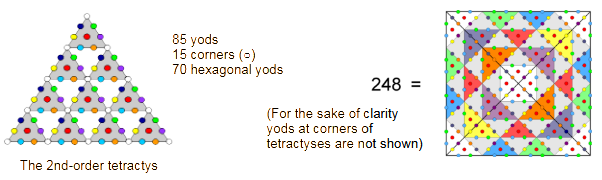
Figure G. Constructed from 2nd-order tetractyses, the square
contains 248 hexagonal yods that symbolize the 248 roots of E8. |
each half having 248 such geometrical elements (for more details, see
Article 55). The number 496 is the dimension of E8×E8′: 496 = 248 + 248. The average Platonic solid embodies in its geometry the very number 496
that, as physicists Michael Green and John Schwarz discovered in 1984, is the dimension of the Yang-Mills gauge symmetry group
guaranteeing interactions between 10-d superstrings that
|
|
|
|
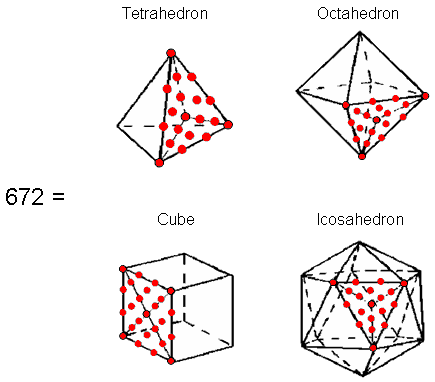
Figure H.
There are 672 yods
in the first
four Platonic solids
constructed from tetractyses.
|
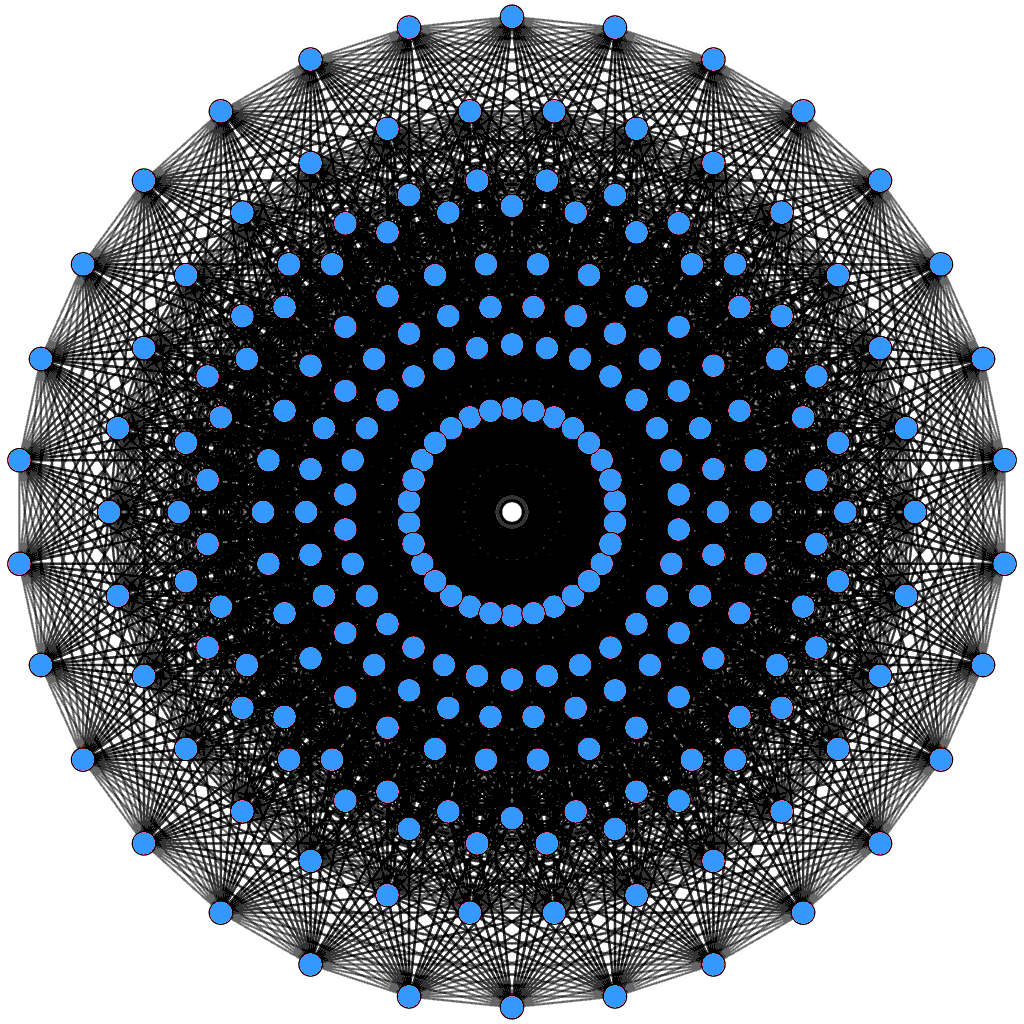
Figure I. The 240 vertices of
the 421 polytope are denoted by blue dots. The black lines
joining them represent its 6720 edges.
|
are free of quantum
anomalies. The Platonic solids embody
both theoretically-derived dynamical parameters and paranormally-derived structural
parameters of the E8×E8′ heterotic
superstrings.
Green, M. B.;
Schwarz, J.
H.(1984). "Anomaly cancellations in
supersymmetric D = 10 gauge theory and superstring theory". Physics Letters
B. 149
(1–3):
117–122.
5
Square representation of the dimension 248 of
E8
The tetractys array of 10 yods made famous by Pythagoras is but the 1st-order member of an infinite class of higher-order
tetractyses, starting with the mathematical point as the 0th-order tetractys. The (n+1)th-order tetractys is generated from the nth-order tetractys by
replacing each of its yods by a 1st-order tetractys. The 2nd-order
tetractys formed from 10 1st-order tetractyses contains 85 yods (Fig. G). This number is expressed by the Tetrad because it
is the sum of the first four powers of 4, starting with 0:
85 = 40 + 41 + 42 + 43.
These yods comprise 15 corners (denoted in Fig. G by white circles) and 70 hexagonal yods
(coloured with the seven colours of the rainbow). Eight hexagonal yods line each side
of the 2nd-order tetractys. When it is a sector of a polygon, they become shared with the adjacent sector, so that there are (70−8=62) hexagonal yods per sector. The
four sectors of a square contain (4×62=248) hexagonal yods that symbolise the 248
roots of the Lie group E8 appearing in E8×E8′ heterotic superstring theory. Notice that
the 40 tetractyses have 41 corners (○). This compares with the 41 yods lining each side of the
square that embodies the structural parameter 1680 of
every whorl of the UPA.
Assigning the Tetrad (4) to yods in the square
arrays
Suppose that the Tetrad is assigned to each yod in the 41×41 array.
Then:
-
the sum of these numbers assigned to the 168 blue
yods surrounding the central yod = 4×168 = 672. This is the number of yods making up the first
four Platonic solids when their faces and their internal triangles are
Type A polygons (Fig. H). The number 168 is the number of yods needed on average to
construct from tetractyses the Platonic solids associated with the four physical
Elements;
-
the sum of these numbers assigned
to the 840 blue and green yods = 4×840 = 3360. This
is also
the sum of the number 4 assigned to
the 840 red yods. Hence, the total sum = 3360 + 3360 = 6720. Compare this
with the 421 polytope,
This 8-d,
semiregular polytope is also known as one of
the three so-called “Gosset polytopes,”
named
after the amateur British
mathematician Thorold
Gosset, who
first published his work on
them in
1900. Its 240 vertices are now known to
represent the 240 non-zero roots of E8. It has 6720 edges, each
half of the
polytope having 3360 edges (Fig. I). A
41×41 array of the number 4 can be
thought of as a representation of these edges, the 840 blue & green yods
with the Tetrad assigned to them representing the 3360 edges in one half of
the 421 polytope and the 840 red yods
representing its other half. In terms of the UPA, whose 10
whorls have 3360 turns in each revolution, every turn being a superposition
of two perpendicular plane waves 90° out of phase, the two sets of 840 yods,
when weighted with the Tetrad, correspond to the 3360 waves and their 3360
out-of-phase counterparts. The blue square with 168 yods weighted with the
Tetrad generates the number 672, which is the number of plane waves making up
each revolution of a whorl. The numbers of blue, green & red yods are in
the proportion 1:4:5. “1” corresponds to a single half-revolution of a whorl,
“1+4” (= 5) refers to its outer or inner half, comprising 2½
revolutions (i.e., “4” refers to its two more
revolutions), and “5” refers, respectively, to
its inner or outer half, which comprises five
half-revolutions.
Assigning the Decad (10) to yods in the square
arrays
Suppose that the number 10 symbolised by the tetractys is assigned to each
yod in the 41×41 array. Then:
-
the sum of the 1680 numbers associated with the 1680 red, green & blue yods = 16800. This is the number of turns in the 10 helical whorls of the
UPA;
-
the sum of the 168 numbers making up the blue square = 1680. This is the number of
turns in each whorl of the UPA;
-
the sum of the 672 numbers assigned to the 672 green yods = 6720. This is the number of
edges ofthe 421polytope (Fig. I);
-
there are nine times as many red & green yods as there are blue
yods. Curiously, the 421 polytope has 60480 triangular faces, which is nine times its number of edges (see here).
As one might expect, given that the number
10 is the
measure of a complete, holistic system, making it the weight for all 1680 yods
in the square arrays generates not only the number of edges but also the number of
faces of the 421 polytope! This cannot be yet another highly improbable coincidence. It stretches
credulity to breaking point to imagine that the same number (6720) could appear by
chance in both the geometry of the 421 polytope, which
represents the 240 roots of the symmetry group E8 in
E8×E8′ heterotic
superstring theory, and the UPA, being the number of plane waves running through its
10 whorls during one revolution. Rather, it
is, surely, evidence that the UPA is an
E8×E8′ heterotic
superstring? The first four Platonic solids provide further confirmation of
this by their displaying
the same sequence of
numbers of geometrical elements that
surround their axes, namely, 168, 336, 336 & 840, i.e., 168, 672 (= 4×168) & 840
(= 5×168), totalling 1680 (= 10×168).
Figure
J
Type
A
square
Type B square
6
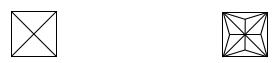
The three prime numbers 13, 29 & 41 that measure the square arrays are
themselves generated by the square. The Type A square has 13 points & lines and
the Type B square has 29 points & lines and 41 points, lines & triangles
(Fig. J).
As previously discussed and illustrated in
Figure C, the 36 triangles making up the Type C square, when turned into tetractyses,
contain 168 yods that surround its centre. This is the number of
yods surrounding the central yod in
the 13×13 array. Weighted with the Tetrad, the
yods in the Type C square generate the number 672. This is the extra number of
yods surrounding the centre of the 29×29 array. Weighted with the Decad
(10), they
generate the number 1680, which is the number of yods surrounding the centre of the
41×41 array.
The number 41 is the 21st odd integer, where 21 is
the gematria number value of EHYEH (אהיה), which is the Godname assigned to Kether,
the first Sephirah of the Kabbalistic
Tree of Life. The number 29 is the 15th odd integer,
where 15 is the number value of YAH (יה), the shortened, often poetic, form of the
full Godname YHVH (יהוה), which is assigned to Chokmah, the second Sephirah.
Is it just coincidence that the Godnames of
successive Sephirah in the Tree of Life prescribe in an arithmetic way the
two largest square arrays? No. True to their archetypal nature, all Godnames
prescribe in various mathematical ways any parameter that quantifies a system
conforming to the divine blueprint, whether it be the Kabbalistic Tree of
Life or another sacred geometry. Examples of this universal power of prescription can
be found in many sections of the author’s website, as well as in his research
articles, which are linked to on
its homepage.
4×4 square array
representations of 496
The
dimension of E8×E8′ is 496. This is
the gematria number value of Malkuth, the tenth Sephirah, signifying in a cosmic
context the physical universe (see
here). As 496 = 16×31, where 31 is
the gematria number value of EL (אל), the Godname of Chesed, meaning “God”, this
number at the heart of superstring theory is the sum of a 4×4 array of the number
31:
| |
31 |
31 |
31 |
31 |
| 496 = |
31 |
31 |
31 |
31 |
| 31 |
31 |
31 |
31 |
| |
31 |
31 |
31 |
31 |
496 is the sum of the first 31 integers:
1 + 2 + 3 +… + 31 = 496,
i.e., it is the 31st triangular number. As
496 = 13 + 33 + 53 +
73,
this number can be represented by a 4×4 square array of the squares of the
first four odd integers:
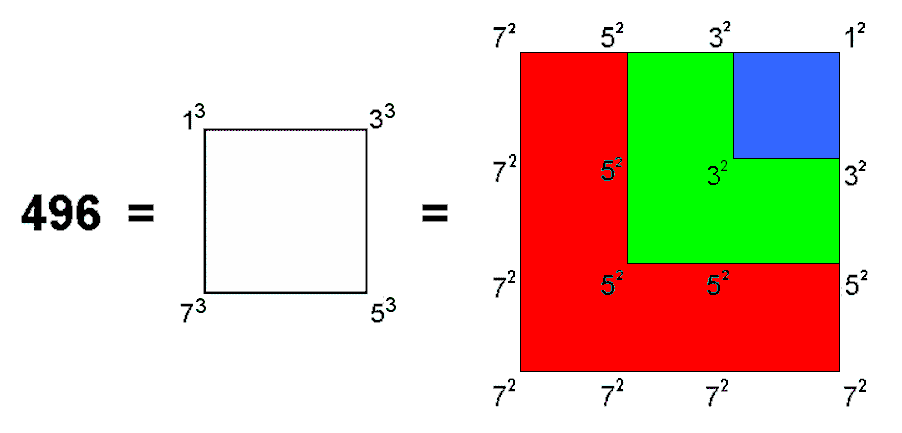
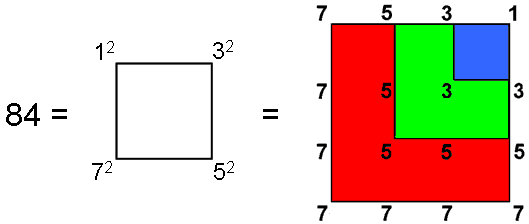
There are 84 circular turns in every quarter-revolution of a helical whorl.
This number has an analogous representation:
Mathematicians call a number “highly composite” if it has more divisors than
all integers smaller than itself. The superstring structural parameter 1680, which we
have seen is both the population of the 41×41 array of yods and the number of
geometrical elements surrounding the axes of the first four Platonic solids, was
ascertained by C.W. Leadbeater through his painstaking counting of the turns
in
It is ironic that the mysterious number 496 so central to superstring theory
should be arithmetically determined by the ancient Hebrew word that translates as
"God." Furthermore, it is remarkable that it should be the gematria number value
of the very Sephirah in the Tree of Life that denotes the physical universe and
means "kingdom." Those who have doubted the veracity of superstring theory should
take note, for there is no explanation for these properties (apart from being an
absurdly improbable coincidence) unless superstrings actually
exist.
7
the helical whorls of UPAs (he counted 135 different specimens!). The number 1680 is the 16th member of
this class of numbers, i.e., it is the largest number in a 4×4 array of the first 16
highly composite numbers:
|
2
|
4
|
6
|
12
|
|
24
|
36
|
48
|
80
|
|
120
|
160
|
240
|
380
|
|
720
|
840
|
1260
|
1680
|
Conclusion
Concentric 13×13, 29×29 and 41×41 square arrays of yods generate certain
structural parameters of the UPA, a basic constituent of atoms that was allegedly
remote-viewed by Annie Besant & C.W. Leadbeater over several decades, starting in
1895. This particle is interpreted by the author as the lightest subquark state of
the E8×E8′ heterotic superstring. From a purely arithmetic
point of view, this representation is not necessarily significant in itself because
it could be just coincidence that there are several integers whose squares generate
these parameters. What, however, makes these particular square arrays truly
significant (and therefore of interest to theoretical physicists) is that exactly the
same sequence of integers appears for the numbers of geometrical elements
surrounding the axes of the first four Platonic solids when their faces and interiors
are constructed from triangles. It is highly implausible that this, too, could arise
by chance. The implication that some deep connection between the Platonic solids and
superstrings, rather than simple coincidence, is the reason for their appearance is
strengthened by the fact that the most basic structural parameter of the UPA, namely,
the number 168, is both the number of geometrical elements surrounding the axis of
the tetrahedron (the simplest Platonic solid) and the number of yods needed on
average to construct from tetractyses one of the first four Platonic solids. These
have always been regarded as possessing sacred geometry ever since the ancient Greeks
thought that they were the shapes of the particles of the physical Elements of Fire,
Air, Earth & Water. Moreover, in Kabbalah, the number 168 is the gematria number
value of the Kabbalistic name of the Mundane Chakra of Malkuth (the tenth Sephirah),
one of whose meanings is the physical universe, which some physicists believe is
composed of superstrings. The square is an ancient symbol for the four Elements. It
is therefore appropriate that it embodies not only this structural parameter of the
UPA but also the dimension 248 of the exceptional Lie group E8 whose
symmetries define the unified force acting between superstrings of this type. These
properties can be regarded as evidence for the author's interpretation of the UPA as
this type of superstring. Further support for this is provided by two remarkable
facts:
-
the average Platonic solid has 496 geometrical elements other than
vertices surrounding its axis, where 496 is the gematria number value of
Malkuth. The 248 geometrical elements in each half that are not vertices are
analogous to the 248 roots of E8 and its copy E8′;
-
the faces of the first four Platonic solids are composed of 248
points & lines when they are Type A polygons.
The number 4 (Tetrad) and the square symbolising it express both
arithmetically and geometrically the structural and dynamical parameters of the
E8×E8' heterotic superstring when the UPA is interpreted as one
of the states of this particle. Their properties illustrate a powerful principle that
the author has called the "Tetrad Principle." Discussed further in Article
1, It states that fundamental, mathematical
parameters of the cosmos — both physical and superphysical — are always
either:
-
the fourth member of a class of
numbers;
-
embodied in the fourth member of a class of mathematical
objects;
-
expressed by the first four integers 1, 2, 3 & 4 that are
symbolised by the four rows of dots in the Pythagorean
tetractys;
-
embodied in the square as the symbol of the Tetrad when its sectors
are Type A triangles, Type B triangles, etc. or 1st-order tetractyses,
2nd-order tetractyses, etc. or when it is just an array of
dots.
8
|